Sunday, April 28, 2013

The Many Meals of Microraptor

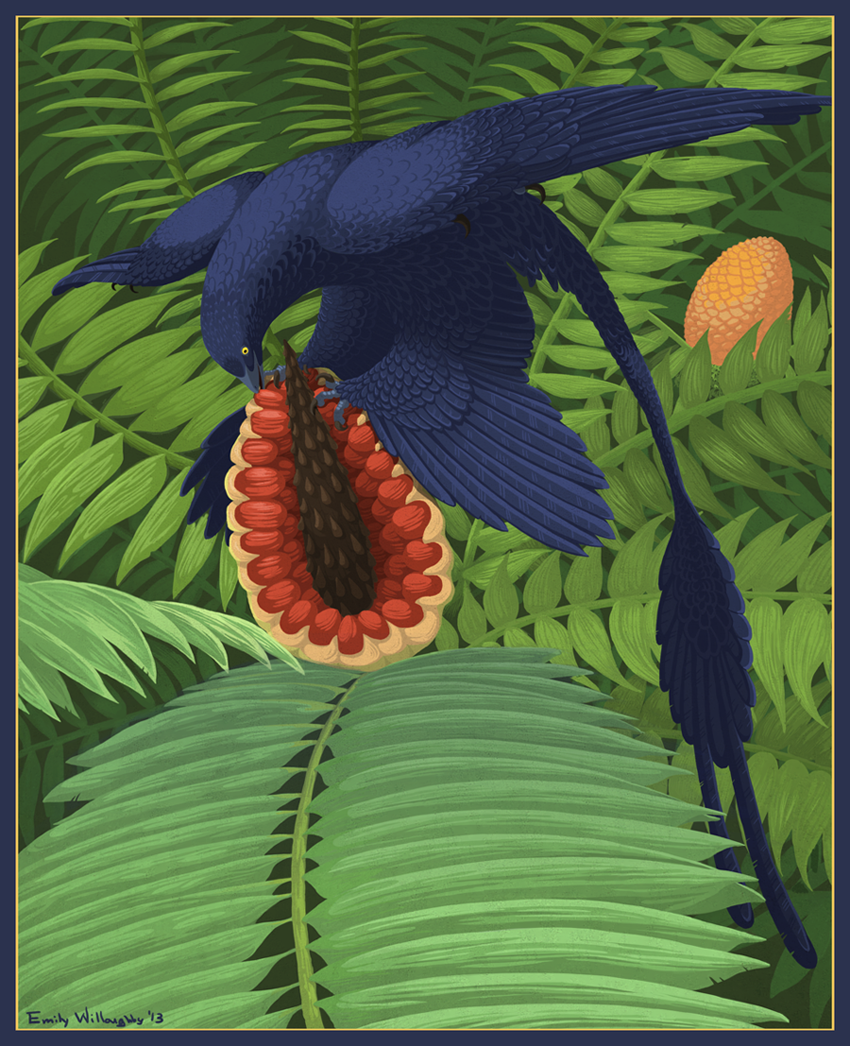
As a lot of you will already know by the time of reading this, a recent publication in the journal Evolution demonstrates that the four-winged, tiny dromaeosaur Microraptor was at least occasionally in the habit of ingesting fish. Scales and portions of several disarticulated skeletons of the osteoglossiform Jinanichthys were found fossilized in the specimen's gut. The authors do not discount the possibility that the fish were scavenged, but considering other known habits of the four-winged wonder, it seems at least reasonably likely that it caught the fish itself - and unlike previous known gut contents, it couldn't have taken this meal in the trees (though it's hard to know what the nay-sayers will claim next...).

Xing et al 2013 describes fish remains in the gut of a Microraptor specimen

This newest study is another piece in the puzzle of Microraptor's ecology - a puzzle which is looking more complete as time goes by. With over 300 undescribed specimens, at least three perserved meals (all different), a color study, conflicting scleral ring studies, and a myriad of biomechanical research, we now know a tremendous about this animal (at least for being dead 120 million years).

But can we extract a reasonable approximation of its diet and lifestyle from the available information? To answer that, one option is to look towards modern birds. But first, let's look at what we do know.

Tuesday, January 29, 2013

Eosinopteryx: a ground-bound troodontid?


Welcome Eosinopteryx brevipenna to the gloriously fuzzy lineup of Chinese paravians!

Eosinopteryx is a new feathered dinosaur from the paleo treasure trove that is Liaoning Province, China. This tiny little fellow, sizing in at only around 30 cm long, was described as being a basal troodontid by the authors: it is extremely similar, skeletally, to Anchiornis, the fuzzy-footed woodpecker mimic famous for being the first dinosaur for whom a complete color study was performed. The fossil of Eosinopteryx, however, clearly lacks a feature for which Anchiornis is unique: it has no long feathers on the feet or ankles, and no tail feathers to speak of either.

It also appears to have rather blunt and short claws on the feet, whereas Anchiornis - tentatively assigned as a sister taxon to Eosinopteryx - had long and curved claws which appear to be the appropriate kind for climbing. Eosinopteryx is therefore considered to be a ground-running animal without the obvious adaptations for arboreality common to its brethren.

This has already been vehemently disputed in the paleo blogosphere, though. It's difficult to discount the possibility that legwings and tail feathers simply didn't preserve in the fossil, and that the animal would have had them in life. It has also been proposed that perhaps Eosinopteryx was a juvenile (most notably a juvenile Anchiornis), and the lack of defined legwings and retrices were a result of its youth and would have come in at adulthood. This is supported by its unusually large head and short snout, features commonly associated with juvenility in birds. However, the authors state that the animal is not a juvenile, as evidenced by closed sutures on the vertebrae - but then again, it has also been mentioned that closed sutures of this nature are sometimes found on animal embryos, so it may make no relevant difference.

In any case, the uncertain phylogenetic position of this pretty little paravian, as well as the general sentiment of "not convinced" by the paleontological community, leaves the importance of Eosinopteryx somewhat up in the air - a place the animal itself may or may not have been occupying.


Godefroit, P.; Demuynck, H.; Dyke, G.; Hu, D.; EscuilliƩ, F. O.; Claeys, P. (2013). "Reduced plumage and flight ability of a new Jurassic paravian theropod from China". Nature Communications 4: 1394. doi:10.1038/ncomms2389.

Saturday, January 19, 2013

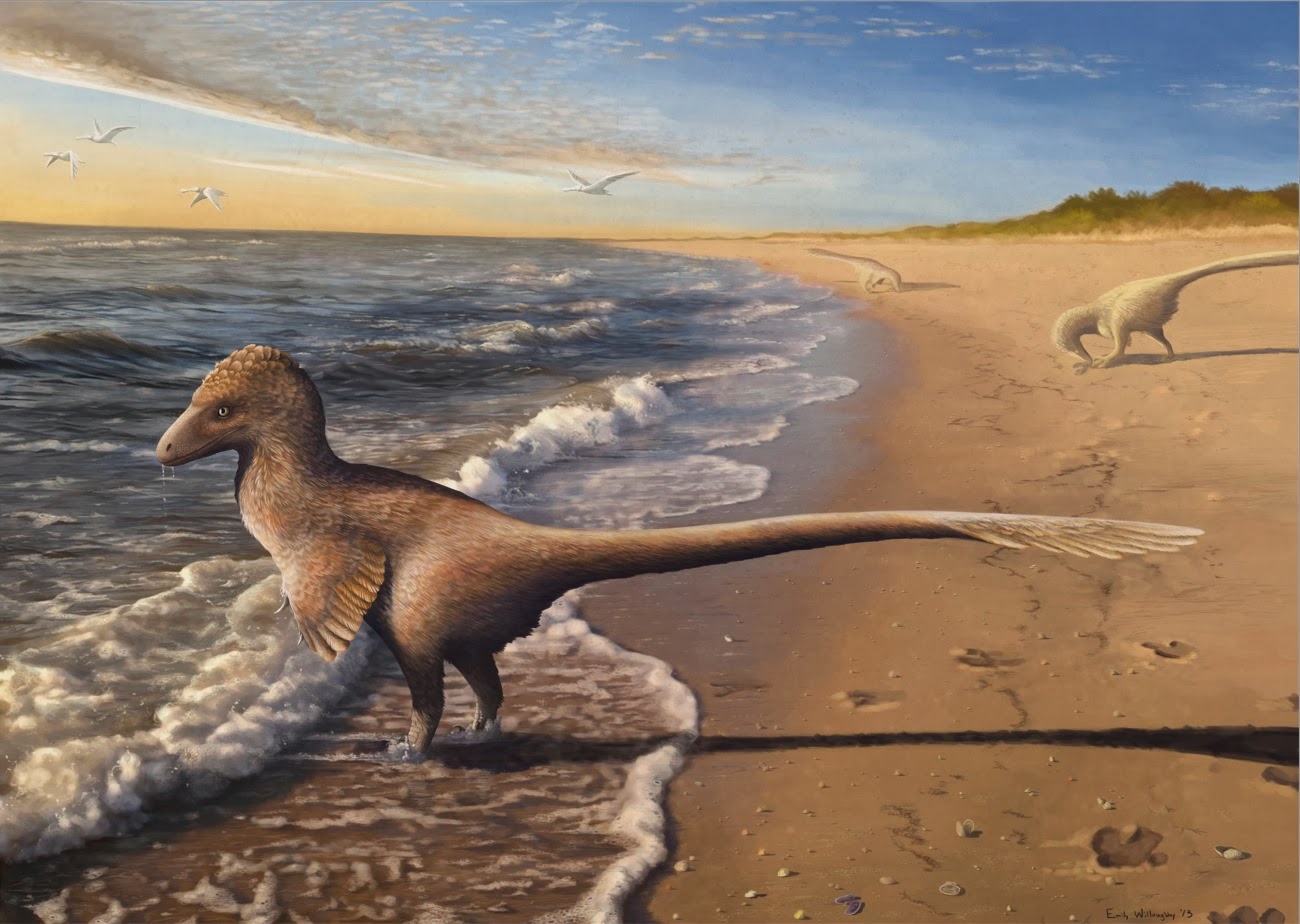
Utahraptor at Dawn


Utahraptor stands in the shallows of the great early Cretaceous inland sea, looking out to the horizon as the sun rises. Utahraptor, though one of the largest dromaeosaurs, was certainly not always taking down large prey in a dramatic and bloody fashion. On this morning, these dromaeosaurs were not hungry enough to hunt, so they combed the beach for shellfish and protein minutiae washed in by the tide. A small flock of ornithocheiroid pterosaurs pass by above.

Tuesday, January 1, 2013

2013 Archosaurs Calendar

Through a collaborative effort over at the Hell Creek paleontology forum, myself and a group of other artists have put together a 2013 Archosaurs calendar! This calendar features, for each month, a dinosaur or other extinct archosaur that was discovered in that month. This includes new specimens and studies as well, such as the Micoraptor color study performed in March.

The cover features all of the individual art found within.

The calendar features art by a total of 11 talented artists, as well as the organization efforts by Albertonykus. Contributing artists include:

Renato Santos
Tom Parker
Durbed
Moritz Dukatz
Guillaume Babey
Adrian Wimmer
Fabio Manucci
Vladimir Nikolov
Christian Masnaghetti
Elia Smaniotto
And myself.

Proceeds from all sales will go to the future production of a children's book on dinosaurs, which will be another Hell Creek collaboration. This project will be an educational effort featuring fully accurate illustrations and information, the like of which is sorely lacking in the current market for children.

In other words, if you buy this calendar, all profit will go to a very good cause!

Here are a few samples of the material in this calendar:

Pegomastax, the South African strange-toothed heterodontosaurid described in October, by Vladimir Nikolov.

A herd of Xenoceratops - a new ceratopsian described in November - on the move, by Chris Masnaghetti.

The December entry, by Elia Smaniotto, rounds out the year and features a parade of hypothetical discoveries that we're hoping to see in 2013, and includes a flightless pterosaur, a feathered sauropod, a sailed ornithopods, and many others.

Buy it here!

Sunday, December 30, 2012

The Evolution of a Microraptor

I've actually had a few people recently comment on my accurate cast shadows in my artwork, so I thought I'd share a little secret.

I have some difficulty composing accurate cast shadows in my head, though I've gotten much, much better at it over the years, thanks in large part to Jon who has been tirelessly critiquing my shading since 2006. He has an almost uncanny ability to rotate three-dimensional objects in his head, an ability that I don't have to quite that degree. However, I have more recently acquired an additional skill in my toolbox for shading, something I learned from the great James Gurney.

Recently I set out to reconstruct a four-and-a-half-year-old picture of mine that had fallen far out of date both in terms of accuracy and artistic proficiency:


This picture was drawn for a publication that, then in its infancy, is now finally bordering on the cusp of maturation, but after the Microraptor color study I knew I had to redo this one to bring it up-to-date. I wanted the composition to remain nearly the same, but the animal itself needed a makeover, and this included the cast shadow.

Lo and behold - I'm actually not terrible at sculpting. Who knew?


Of course, this sculpt involved just the barest of details, and will probably never be "completed" in the sense of being a finished sculpture, but I did my best to make it anatomically accurate and it certainly served its intended purpose. The basic lateral anatomy is based on the original drawing in Xu Xing 2003:


And then beefed up with what I know of dromaeosaurid and bird anatomy with a very lightweight type of modeling clay.

Using the guideline of the model, I could then create the finished image with cast shadows intact.


Obviously this sort of process is far too time-consuming to use on everything I draw, but it's kind of fun for more important paintings that need to be as accurate and consistent as possible.

Sunday, November 25, 2012

'All Yesterdays' Book Review

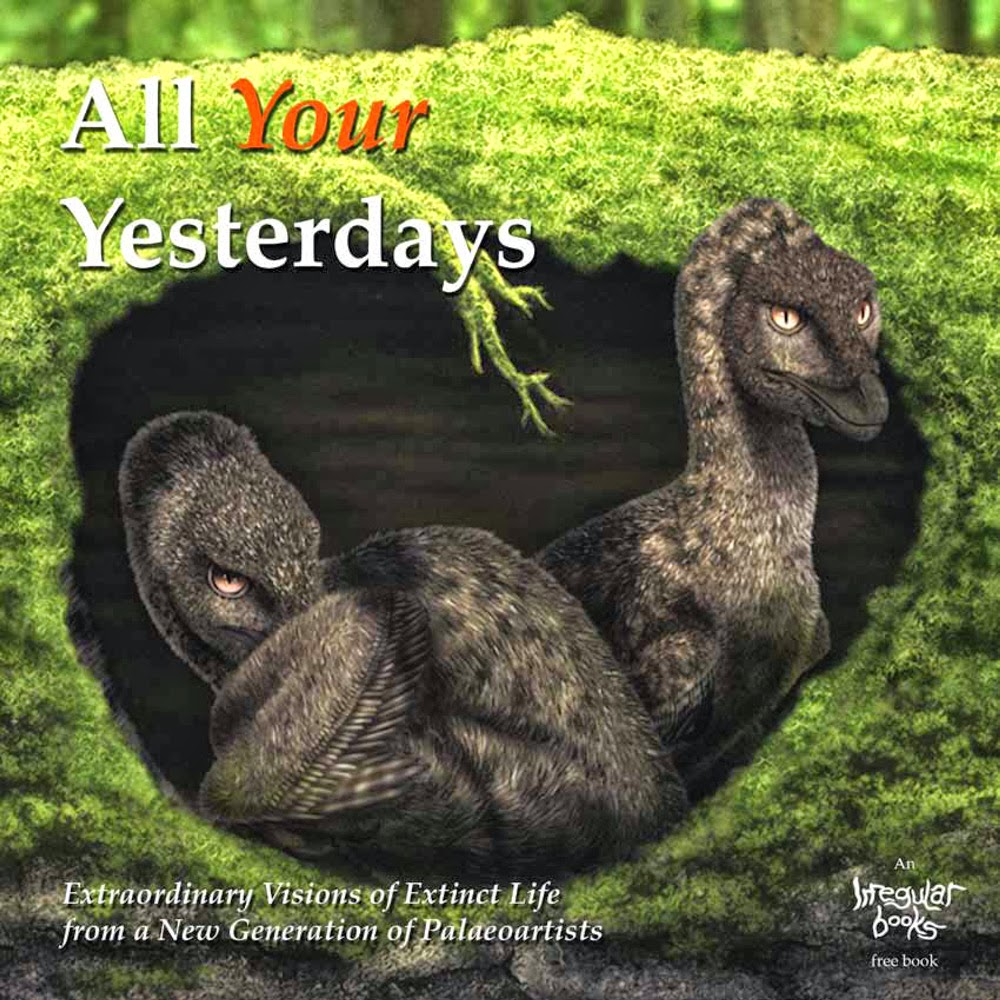
Many of you are probably aware of the new paleoart book All Yesterdays, written by Darren Naish of TetZoo, John Conway, C.M. Koseman, and Scott Hartman, and illustrated by the latter three. Right now only the Kindle edition is available on Amazon, but the print version should be out soon, last I asked. In any case, I'd eagerly awaited this book for some time, and wanted to write a review for Amazon after it was released. I thought I'd post my review here as well in the hopes of inciting the interest in my paleo-minded followers.


Conway's illustration of Protoceratops in a tree serves as the book's cover, and demonstrates the idea that animals can do things they don't necessarily do all the time

Sunday, July 29, 2012

The Neck is a Lie

Matt Wedel of SV-POW has a pair of old articles on how necks lie, illustrating in a general sense that the skeletal structure of an animal is often at odds with its physical appearance. No part of the skeleton emphasizes this discrepancy more than the neck, especially in birds. These have always been some of my favorite SV-POW posts, not just because of how crazy it is to see a budgie's cervicals overlap its trachea, but because the prevaricative nature of the neck has a great deal of application to paleontographic reconstructions of dinosaurs.

Ardeidae, the heron family, demonstrates an excellent variety in neck shapes and neck capabilities. Most of us are familiar with larger heron species, like the great blue and the great egret. Both of these birds are very large, and have extremely long, serpentine necks. But these necks don't lie - by paleontography standards, they are almost "shrink-wrapped" in appearance, and clearly show the accurate contour of the vertebral column.


Look at that glorious S-curve.